Hi, i'd like to brew an australian sparkling ale..I have some doubt about the yeast...what do you prefer? I have no experience with Australian Sparkling Ale!!! Wyeast 1098 british ale or Wyeast 1312 london Ale III? Thanks Daniele
Hi all selling my lovely 4V system due to not brewing.
Consists of
75L Blichmann Boilermaker kettle. Cost nearly $800 on its own. Has one slight sent on edge of base seen in photo from outside and also near brush tip on inside. This was from slip while cleaning. Otherwise is as new basically.
70L Techni ice esky kitted with tap and cam lock fittings, copper mainifold false bottom and sparing.
50L Birco urn as HLT with cam locks
20L urn as Herms with copper coil with cam locks...
last year we had quite a thread going on grumpies about music people are listening to and everyone had a good go at paying everyone one else out for there music. mind you i think i copped most the flack. no tangent i don't drive a valiant or where flannies. (what happened to our mate tangent anyway)
anyway you all know iam a led zepplin freak. but i can't pick a best zep tune its impossible. but i think my vote for all time greatest tune goes to the stones for sympathy for the devil. iam...
Read the spiel below but the tl;dr is: -use with external thermostat -quiet, chills to 2 deg no problem -fit 2 full size cornies or just a 30L plastic fermenter (I think it would also fit a ss brewbucket too) -it's only $30, pick up 4051
Westinghouse RA141S-R bar fridge used for home brew.
Will need to use with an external thermostat as internal is broken. Can include a 'mashmaster fridgemate' - haven't calibrated but probe seems to be working (came with the fridge I now have but I have an...
Decugnano dei Barbi vineyard / Photo by Nick Cornish
Central Italy is home to classic white wines made from native grapes that yield dry, delicious pours with character and energy. The best, like top Verdicchios from the Marche region, also have surprising longevity.
In the past, overcropping to increase quantity tarnished the reputation of many of these fantastic wines. However, today's quality-minded producers make elegant, focused white wines that should be on every wine lover's radar.
Giovana Madonia vineyard in Emiglia-Romagna / Photo courtesy Giovana Madonia
From the southern part of Emilia-Romagna region, where northern Italy meets the central part of the peninsula, this is the region's premier white.
Known as Albana di Romagna until 2011, it's made with a minimum of 95% of native grape Albana, though most producers exclusively use the variety. It's cultivated in a diverse area of undulating hills and valleys that stretch between the Apennine mountains to the Adriatic Sea. The area has diverse soils including clay and limestone, while cooling sea breezes temper the Mediterranean climate. Perhaps most famous for its sweet wines and passitos made from withered grapes, the dry Secco versions range from crisp and linear to enveloping, complex and fresh. Typical aromas include wildflowers, stone fruits and honey, while flavors range from yellow peach to apricot to bitter almond.
Suggested producers: Celli, Giovanna Madonia, Tre Monti
The winery at Tenuta Calcinaie / Photo courtesy Tenuta Calcinaie
Celebrated for structured reds like Brunello, Vino Nobile di Montepulciano and Chianti Classico, Tuscany is also home to the white wines of Vernaccia di San Gimignano. Poured at noble courts throughout Europe at the end of the 13th century, it's one of Italy's most storied wines.
Vernaccia di San Gimignano's growing zone lies on hillsides between 656 and 1,312 feet above sea level in the municipality of San Gimignano, in the Siena province. Soils are marine deposits of Pliocene origin and consist of yellow sand and clay. It's not uncommon to find ancient marine fossils as you walk through the vineyards. The sandy soils lend savory notes to Vernaccia di San Gimignano.
Made with at least 85% of the Vernaccia grape, this dry, delicately scented white comes in two styles. The straight version is fresh, floral, fruity and ready to enjoy immediately, while the more complex Riserva versions take on notes of honey and flinty mineral with age.
Suggested producers: Montenidoli, Tenuta Le Calcinaie, Teruzzi & Puthod
Once more famous for its unique green amphora and fish-shaped bottles than for the wines they contained, Marche's flagship variety, Verdicchio, is now one of Italy's greatest white wines.
Wines made from the variety range from crisp and easygoing to complex and seriously ageworthy. Verdicchio dei Castelli di Jesi, the larger of the two dedicated denominations, extends across the hills around the town of Jesi, in the province of Ancona. The wine comes in several versions that include Classico, Classico Superiore and Riserva. The growing area has calcareous, clay and limestone soils, and it boasts a relatively dry maritime climate influenced by the Adriatic.
The tiny Verdicchio di Matelica appellation, further inland, has a more continental climate that produces racy wines with even higher acidity. It also has a Riserva version that ages well.
For decades, quality had waned. Verdicchio became associated with cheap, uninspiring wines destined for immediate consumption. Legendary producer Ampelio Bucci is credited with ushering in quality winemaking during the early 1980s with his Villa Bucci Riserva. Made with low grape yields and aged in large Slavonian casks, it has incredible elegance, complexity and longevity.
Top-tier Verdicchios feature floral and beeswax aromas, citrus, with yellow stone fruit and white almond flavors. The best Castelli di Jesi offerings also have savory saline mineral notes, while top expressions from Matelica are focused, with intense energy.
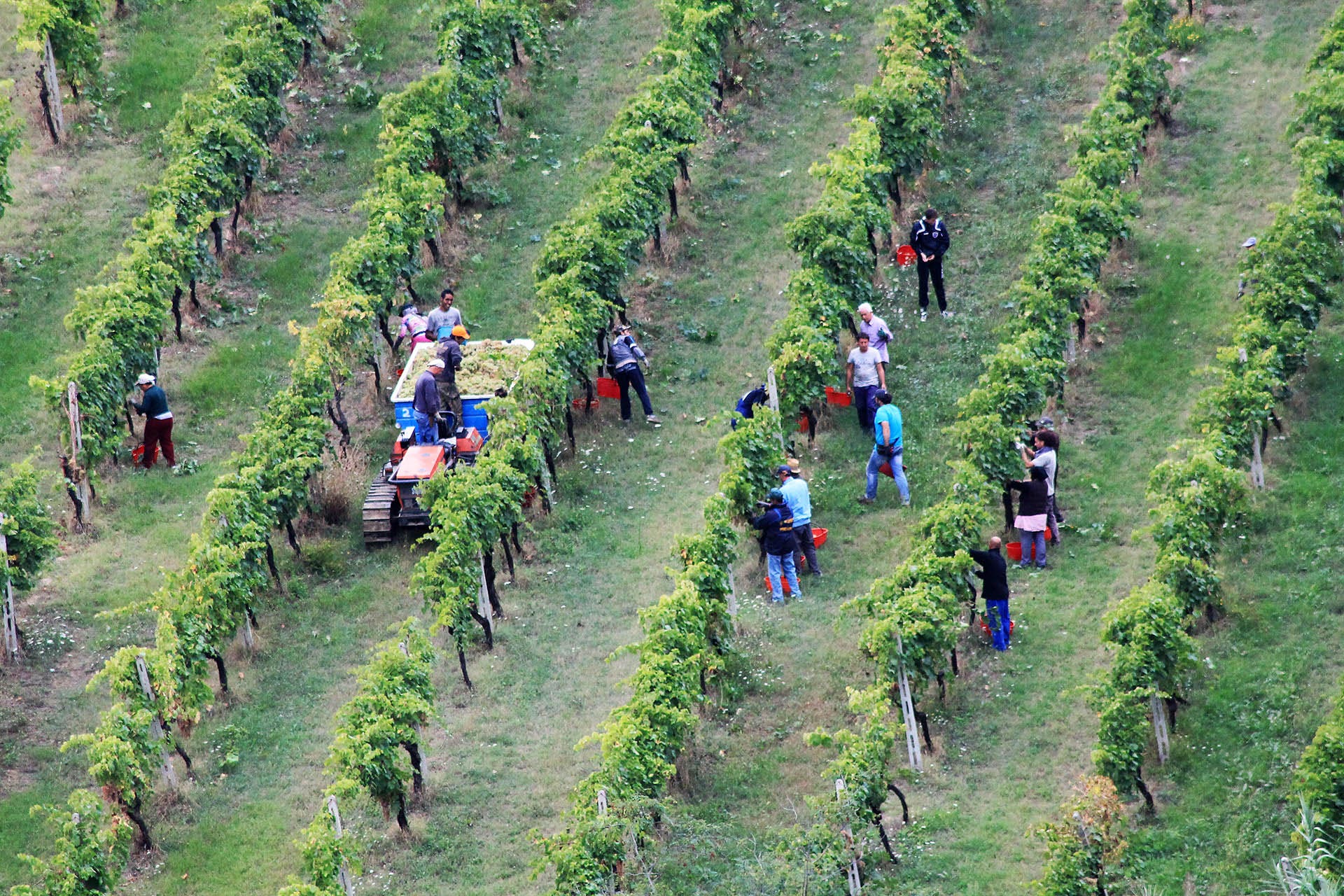
Harvest at the Decugnano dei Barbi vineyard in Orvieto / Photo by Nick Cornish
Known as the "Green Heart of Italy," Umbria is the only landlocked region in the central part of the country, bordered by Tuscany, Marche and Lazio. Known for full-bodied reds like Montefalco Sagrantino, the region also makes crisp, refreshing whites. Orvieto, the region's most storied white, is named after the town where it's found. The wines are produced in both sweet and dry styles.
The Oriveto denomination, which has a Classico, or original growing area, stretches from Umbria to Lazio. Wines are made from a blend that includes Procanico, a clone of Trebbiano, and Grechetto. Orvieto's array of soils includes tufaceous zones of volcanic origin to the south, clay in the center, sand interspersed with marine fossils in the northeast and silty alluvial soil along the Paglia River.
Dry Orvieto is crisp, with exotic fruit, peach sensations and tangy acidity. Classico Superiore versions have creamy textures and fresh acidity, while those made in volcanic soils around Lake Bolsena have salty notes.
Suggested producers: Barberani, Decugnano dei Barbi, Marchesi Antinori Castello della Sala
A native grape from Central Italy, Pecorino thrives in the gentle hills around Ascoli Piceno in Marche, and in neighboring Abruzzo.
Nearly extinct in the early 1980s, the grape was saved by local trailblazers like winemaker Guido Cocci Grifoni. After years of experimentation, Grifoni made his first vintage of 100% Pecorino in 1990.
More wineries in both regions now produce this wine, thanks to its intense floral aromas of acacia and jasmine, white stone-fruit flavors, creamy texture and savory mineral notes. Tastings of older vintages prove that when made with care, Pecorino can be surprisingly ageworthy.
Suggested producers: Cantina Tollo, Clara Marcelli, Tenuta Cocci Grifoni
Trebbiano d'Abruzzo
Region: Abruzzo
Trebbiano d’Abruzzo harvest at Emidio Pepe / Photo by Anca Emanuela Teaca via Alamy
Normally a workhorse grape, Trebbiano is planted widely throughout Italy, and it usually produces uninspiring wines at best. However, one clone, Trebbiano d'Abruzzo, has been cultivated for thousands of years in this region. It has an extremely long growing season that generates complexity and longevity.
While up to 15% can include other white grapes, the best iterations tend to be made entirely from Trebbiano d'Abruzzo. Top bottlings have elegance, depth and mineral-driven sensations that develop with age.
A small crop of American winemakers is brightening up fortified wines with summer-friendly pink bottlings. In doing so, these producers are putting their own twists on ancient traditions.
Made by adding grape brandy to a still rosé during the fermentation process, these offerings typically fall somewhere between 17–20% alcohol by volume (abv). They shine when they’re served with cheeses as an aperitif or alongside dessert, and like their lower-proof rosé cousins, they are best enjoyed chilled.
These three bottlings are a great introduction to this blossoming style.
The idea for this wine started in 2016, with the rare Oregon vintage that yielded a secondary crop. Winemakers Pattie and Mark Björnson used the bonus Pinot Noir grapes to make a pink-hued ratafia, a fortified wine commonly made in Champagne with extra grape juice from harvest. The fortified rosé, which Mark describes as a "pinkish, amber Port," was a hit, and the winery has made small batches of the bright and berry-flavored dessert wine ever since.
Originally from Portugal, Winemaker Jorge Raposo is naturally drawn to Port-style wines. After opening his Virginia winery in 2015, he set out to make his own American version of fortified rosé with Chambourcin grapes, modeled, of course, after his home country's famed fortified wine.
"Rosé Ports are all about fresh fruit," he says. "This is a summer Port, one you'll actually want to drink on a hot day in August."
Inspired by the wines of Jura, with a nod to California's rich history of making Angelica, a sweet fortified wine, Chris Brockaway set out to make a unique wine from Valdiguié grapes. The rosé, fortified with local brandy, sat untouched in the barrel for five years. Despite that aging, the wine is refreshing.
"It's a lighter concept of what's considered to be a heavy wine," says Brockaway, who believes "it's nice to drink something that gets your mind working."
Those new Sommelier Select and Winemaker's Master Vintner wine kits? 10% off. The newest Tropical Bliss flavors? 10% off. That bigger kettle you're wondering if you really need (and you do)? Yep, 10% off. Grab your goods before the sale ends and so you can enjoy the rest of the weekend knowing you snagged all the deals.